
Generic Ozempic Is Here. Will Your Drug Plan Actually Save Money?

Generic Ozempic Is Here. Will Your Drug Plan Actually Save Money?

If drug costs have been climbing on your group benefits plan, GLP-1 medications like Ozempic are likely part of the reason. These drugs have been among the fastest-growing cost drivers in employer-sponsored plans across the country. So when Health Canada approved a generic version of semaglutide, the active ingredient in Ozempic, on April 28, 2026, and a second generic followed in early May, it was welcome news for anyone managing a group drug plan. Canada was the first G7 country to approve a generic semaglutide.

But here is the thing: lower costs are not guaranteed just because a cheaper version of the drug exists. Whether your plan actually sees savings depends almost entirely on how it is designed.

What Happens When a Drug Goes Generic?

When a brand-name drug loses patent protection, other manufacturers can produce and sell equivalent versions at a lower cost. The savings can be significant.

As a rule of thumb in the industry, when one or two generics enter the market, prices may fall by 20 to 30 per cent below the brand-name drug. With more generics competing over time, those discounts can deepen further. These are general industry estimates, and actual outcomes will vary.

For Ozempic specifically, this could translate to roughly one to two per cent savings on a plan’s total drug costs. That may sound modest, but for organizations with meaningful Ozempic spend, it adds up quickly, especially at renewal.

Why Savings Do Not Happen Automatically

Here is where many plan sponsors get caught off guard: the existence of a generic does not mean your plan will automatically pay for it at the lower price.

Without specific plan design provisions in place, many members may stay on the brand-name drug. Their doctor prescribed it. They have been taking it. They may not even know a generic exists. And if your plan covers it without any substitution requirement, there is little reason to switch.

The result is a plan that may continue paying brand-name prices for a drug that now has a lower-cost equivalent on the market.

What Plan Sponsors Can Do Right Now

The arrival of generic Ozempic creates a real window to act, but it requires a conversation with us. Here are the three areas worth reviewing:

Generic substitution policies. Many plans already have mandatory substitution clauses that require members to use a generic when one is available, unless there is a medical reason not to. If your plan does not have this in place, or if it only applies to certain drug categories, now is the time to review it. Adding generic substitution for GLP-1 medications could meaningfully reduce what the plan pays.

Prior authorization requirements. Prior authorization means a member needs approval before the plan will cover a specific drug. This is particularly useful for high-cost medications where clinical criteria should be confirmed before coverage is granted. It also creates a natural point to direct members to the generic option. If your plan does not currently require prior authorization for GLP-1 medications, that is worth exploring with your insurer.

Brand-name pricing negotiations. In some cases, insurers may be able to negotiate pricing directly with brand-name drug manufacturers. This is not a standard plan-design feature, but it is worth asking your insurer whether it is an option and whether brand-name semaglutide pricing is available through their arrangements. If it is available, it could help reduce costs even for members who remain on the brand-name drug for medical reasons.

The Bigger Picture on Plan Design

Generic Ozempic is a useful reminder that drug plan management is not a set-it-and-forget-it exercise. Small design decisions, like whether a plan has a substitution clause or a prior authorization requirement for high-cost drugs, can translate into real, measurable differences in cost over time.

For organizations that have seen drug costs climb in recent years, this is a meaningful opportunity. The savings potential is real. Whether your plan captures it depends on reviewing your plan design and having a conversation with us before your next renewal.

This content is provided for general informational purposes only. It is not intended to provide investment, tax, or legal advice, and should not be relied upon as such.

Sources:

What Happens to Your Group Benefits When You Leave a Job?

What Happens to Your Group Benefits When You Leave a Job?

Leaving a job, whether by choice or by circumstance, brings a long to-do list. Updating your resume, signing new paperwork, figuring out your finances. One item that often gets missed in the shuffle: your group benefits.

For many Canadians, employer-provided health, dental, vision, and life insurance coverage quietly disappears the moment they leave. Here is what actually happens, what your options are, and what steps to take so you do not end up without coverage when you need it most.

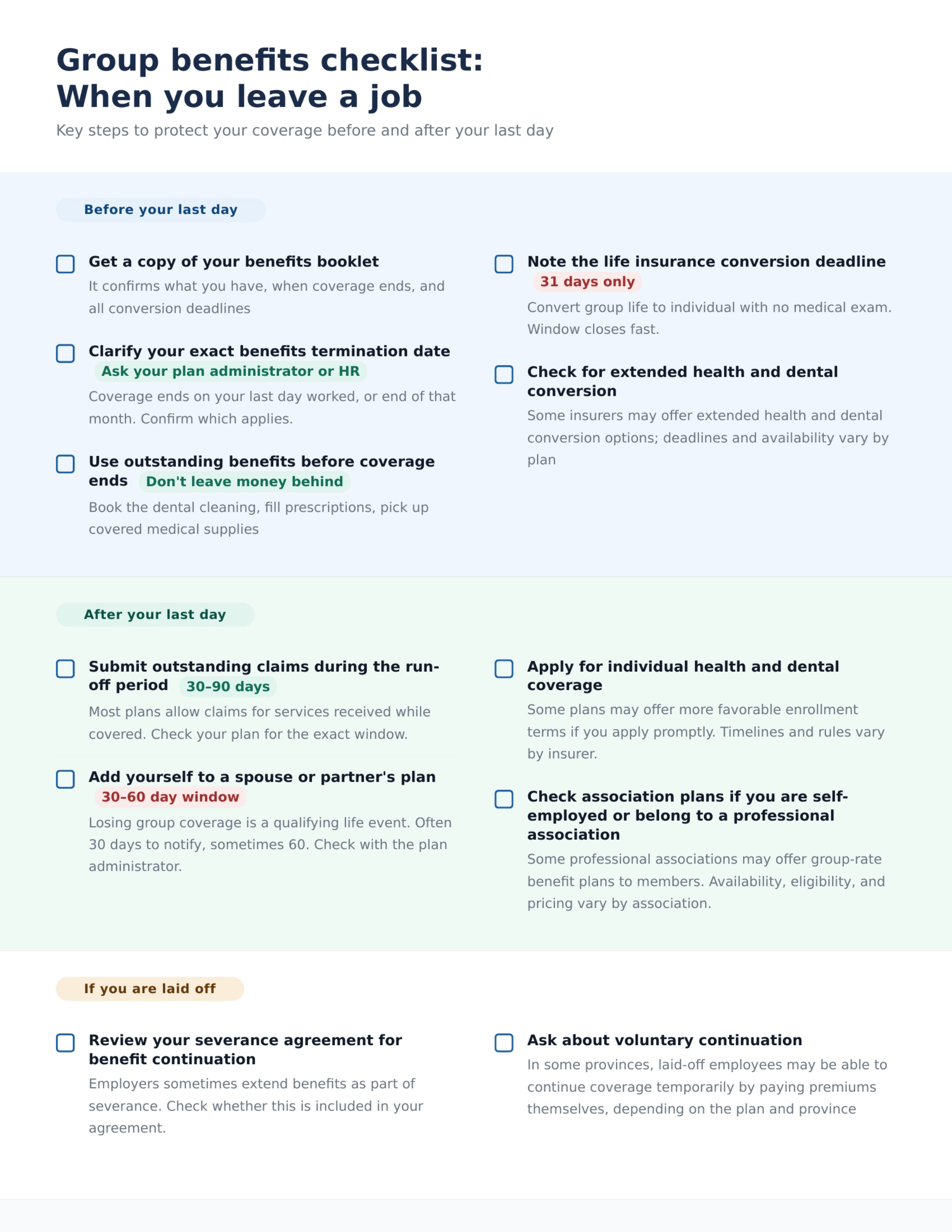
When Does Coverage End?

The exact end date depends on your employer’s plan, but most group benefits plans terminate coverage on one of two dates:

  • The last day of active employment, meaning your coverage ends the day you stop working.

  • The last day of the month in which you stop working, which gives you a short buffer.

Your employee handbook or HR contact can confirm which applies to your plan. If you are being laid off or terminated, sometimes an employer will extend benefits for a defined period as part of a severance arrangement, this should be spelled out in any severance agreement you receive. In some provinces, such as British Columbia, employees who are laid off may also have the option to voluntarily continue their coverage for up to six months by paying the premiums themselves.

The takeaway: do not assume coverage continues past your last day. It usually does not, and even a brief gap can leave you on the hook for expenses.

brandableContent

What Coverage Goes With You, and What Disappears

Not all group benefits disappear the same way. Here is what typically happens with each type:

Health and dental: These end on your termination date (or end of month, depending on the plan). Most plans include a run-off period, typically 30 to 90 days, to submit claims for services you received while you were still covered. Any claims for services after your termination date will be denied. Before you leave, it is worth getting any outstanding treatments done and filling any prescriptions. Some insurers also offer conversion options for extended health and dental coverage within 60 to 90 days of losing group coverage, though this is less common than life insurance conversion.

Vision: Same as health and dental, coverage ends, and unused benefit maximums do not transfer.

Life insurance and accidental death and dismemberment (AD&D): Group life insurance through your employer is usually converted to an individual policy without medical evidence through a feature called the conversion privilege. This is one of the most important and least-known options available to departing employees.

Short-term and long-term disability: These stop when employment ends. You cannot claim disability benefits from a former employer’s plan after your last day. If you are already on a disability claim when you leave, the rules get more specific, check your plan documents.

Employee Assistance Programs: These end at termination as well.

The Conversion Privilege: A Rarely Used but Valuable Option

Most group life insurance plans come with a conversion privilege, the right to convert your group life coverage to an individual permanent life insurance policy without providing evidence of insurability. That means no medical questions, no physical exam.

There is a catch: you typically have only 31 days from the date your group coverage ends to exercise this option. Miss that window, and you lose it.

The converted policy will cost more than your group coverage did. Group rates are typically lower because the risk is pooled across all employees. An individual policy reflects your age and the fact that the insurer cannot screen for health. But for someone who has developed a health condition during employment and would otherwise have difficulty qualifying for individual coverage, this option is a lifeline.

Contact your former employer’s benefits administrator or the insurer directly to find out the exact deadline and how to start the conversion process.

Your Options for Replacing Health and Dental Coverage

Once your group plan ends, you have a few paths to replacing health and dental coverage:

A spouse or partner’s plan. If your partner has their own employer plan, losing your group coverage is typically considered a qualifying life event that allows them to add you immediately, without waiting for an open enrollment period. Act within 30 to 60 days of your coverage ending, as most plans require prompt notification.

Individual health and dental insurance. Insurance companies offer individual health and dental plans that you can apply for on your own. Premiums are higher than group rates, and pre-existing conditions may not be covered, but this option fills the gap if no group plan is available to you. Many providers allow applications within 60 days of losing group coverage to waive certain waiting periods.

Professional or industry associations. Some professional groups, engineers, teachers, freelancers, offer group benefit plans to members at better rates than individual plans. If you belong to or qualify for membership in an association, this can be worth exploring.

What to Do Before Your Last Day

A few practical steps to take before you walk out the door:

Get a copy of your benefits booklet or summary plan document. This outlines exactly what your plan covers, how conversion works, and the deadlines involved. HR should be able to provide this.

Use what you can before your coverage ends. Book that dental cleaning, fill outstanding prescriptions, and pick up any medical supplies covered under your plan. Most people leave money on the table simply by not timing this properly.

Clarify your exact termination date for benefits purposes. Ask HR explicitly whether benefits end on your last day worked or at the end of that month.

Check the conversion privilege deadline. If you have any concern about qualifying for individual life insurance, find out your deadline immediately and do not let it pass.

Notify your partner’s employer. If you plan to join your partner’s group plan, they need to notify their plan administrator within the required window, typically 30 to 60 days.

The Gap You Do Not Want

Going without health and dental coverage for even a short time can be expensive. A single dental emergency, a course of prescription medication, or a specialist visit that falls outside provincial coverage can cost hundreds to thousands of dollars out of pocket.

The good news is that a gap does not have to happen. With a bit of planning and quick action after your last day, you can move from one source of coverage to another without interruption.

Have questions about your coverage options? We are here to help. Reach out to our team and we will walk you through what makes sense for your situation.

This content is provided for general informational purposes only. It is not intended to provide investment, tax, or legal advice, and should not be relied upon as such.

Sources:

Helping Employees Get the Most Out of Their Health Benefits

Helping Employees Get the Most Out of Their Health Benefits

You can provide the most generous benefits package in the world, but if employees don’t understand how to use it, it won’t have the impact you hoped for. Across Canada, many employees leave valuable health and wellness resources untapped simply because they don’t know what’s available or how to access it. For business owners and HR professionals, educating employees about their benefits isn’t just a nice extra—it’s an essential step toward creating a healthier, more loyal, and more productive workforce.

When Benefits Go Unused, Everyone Misses Out

Offering benefits is a major investment. Extended health coverage, dental care, paramedical services, and wellness allowances all come with costs to the company. When employees fail to take advantage of these resources, it’s not only a missed opportunity for them—it’s also a lost return on investment for the organization.

Imagine a scenario: an employee suffers ongoing back pain but doesn’t realize physiotherapy is covered under your plan. They avoid treatment, their pain worsens, and productivity drops. Months later, a preventable issue becomes a bigger concern that impacts both their well‑being and your team’s efficiency. This is what happens when benefits are underused—they don’t provide the intended health, morale, or retention impact.

Educating employees ensures they view benefits not as fine print in a handbook but as tools to support their daily lives. A team that knows how to access preventative health care, mental health services, and family coverage options is a team that stays healthier and feels more valued.

Why Health Benefits Education Can Be Challenging

Despite the clear value, helping employees understand health benefits often comes with hurdles.

Information overload on day one: New hires receive a mountain of onboarding materials. By the time they get to the benefits booklet, attention and energy are running low.

Confusing terminology: Words like “deductible,” “co‑insurance,” or “coordination of benefits” are not part of everyday language. Without translation into plain English, many employees tune out.

Irregular communication: Many organizations only discuss benefits once a year during open enrollment. Without reminders or ongoing conversations, details fade quickly.

Reactive awareness: Employees often learn about benefits only when a medical issue arises. By then, stress and urgency can make it harder to absorb new information.

Turning Health Benefits into Everyday Value

Clear and consistent communication helps employees view their benefits as practical tools rather than abstract policies. Here are strategies to bring health benefits to life:

Break information into small, digestible pieces
: Instead of a single benefits session, share one feature at a time. For instance, start with paramedical coverage one month, mental health supports the next, and vision care later. This keeps information approachable and memorable.

Use relatable examples
: Paint a picture of real-life use. “If your child needs braces, our dental plan can cover 50% of the cost up to $2,000” is easier to grasp than a page of percentages and annual maximums. Stories connect the benefit to employees’ daily lives.

Incorporate wellness education into your culture
: Lunch‑and‑learns, wellness newsletters, or quick “Did you know?” messages in internal chats can keep health resources top of mind. The goal is to normalize talking about benefits as part of workplace well‑being.

Highlight preventative care
: Preventative services—like annual eye exams, physiotherapy after minor strains, or mental health counselling—often save employees and employers from bigger issues down the road. When staff understand that benefits support staying healthy, not just reacting to illness, they’re more likely to use them proactively.

Offer multiple ways to learn
:
Some employees prefer reading a guide, others learn best through short videos, and some want to ask questions in a small group session. A mix of formats ensures the message reaches everyone.

Measuring the Impact of Your Efforts

It’s important to know whether your education efforts are working. Instead of guessing, consider these approaches:

Track utilization rates for paramedical services, wellness allowances, and mental health support. An increase often reflects better awareness.

Monitor enrollment levels for optional coverage, such as enrolling in optional critical illness protection.

Collect employee feedback via short surveys to gauge confidence in understanding their benefits.

Watch for retention improvements and fewer sick days, as engaged employees tend to stay longer and take a more proactive approach to their health.

Even small increases in understanding can create noticeable improvements in morale and the return on your benefits investment.

When employees know their benefits, they feel supported. When they use those benefits, they’re healthier, happier, and more productive. And when they see their workplace investing in their well‑being, loyalty naturally grows.

Helping employees understand their health benefits is an ongoing effort, not a single presentation. If your organization hasn’t revisited how benefits are communicated, this is a perfect time to start. A clear, proactive education strategy can turn an underused expense into a meaningful tool for engagement and wellness.

We can help you create a tailored communication strategy to educate your team, improve benefit utilization, and strengthen employee loyalty.

Disclaimer: This article is for informational purposes only and does not constitute financial, legal, or tax advice. Always consult a qualified professional regarding your specific situation. We are not responsible for any actions taken based on this content.


Renewing Your Group Benefits Plan

When it’s time to renew your organization’s group benefits plan, it’s a chance to step back, take a close look, and ensure everything still makes sense for your team and budget. Each year, your provider will review past claims and usage to help adjust coverage and premiums, so the plan remains relevant. Here’s how to get the most out of this process.

Reviewing Your Benefits: Focus on What Matters

Take time to examine each part of your benefits package to see if it still meets the needs of your team:

  • Health Coverage: Look at what’s covered for prescription drugs, hospital care, and specialist visits. Are the current limits in line with what your team uses most?
  • Dental Coverage: From cleanings to crowns, check that the plan covers routine and advanced dental needs. If usage is low, maybe it’s time for an update.
  • Disability and Life Insurance: Disability insurance protects income during tough times, while life insurance gives peace of mind. Make sure coverage levels are right for your team.
  • Critical Illness and Accident Insurance: These benefits can provide extra financial support for serious illnesses or accidents, with options for additional coverage if it’s a priority for employees.

Specialty Benefits That Add Flexibility

Consider adding options that give employees more control over their benefits:

  • Health Care Spending Accounts (HCSAs): With HCSAs, employees have a set allowance to cover eligible health expenses. This flexibility lets employees pick and choose the coverage that fits their needs.
  • Emergency Medical Coverage: This can be particularly valuable for employees who travel frequently, covering unexpected medical costs on the road.
  • Retiree and Self-Employed Benefits: If you offer benefits for retirees or contractors, make sure these plans focus on the essentials, like prescriptions, dental, and vision, to keep things simple and effective.

Checking Value and Staying on Budget

Once you know what you’re covering, see if it aligns with what your team values most and if it’s worth the premium cost:

  • Utilization Analysis: Look at which benefits are most used. If something like dental care isn’t being used much, that could mean there’s room to adjust.
  • Employee Feedback: Ask employees directly what benefits do they find most valuable? This feedback can guide your decisions.

Making the Right Adjustments

When you have the full picture, it’s time to consider if adjustments would make the plan stronger or more efficient:

  • Benefit Modifications: Maybe it’s time to add a health spending account, adjust critical illness coverage, or tweak other benefits to better reflect what employees want.
  • Cost-Sharing Adjustments: Evaluate how the premium costs are split. Adjusting the cost share may help keep the plan sustainable for everyone.

With the right approach to your group benefits renewal, you can keep your plan valuable, easy to understand, and tailored to what your team needs most. This way, you’re not just offering a benefits package—you’re providing a solution that works.

Exploring the Value of Group Benefit Plans for Your Employees

In today’s ever-evolving workplace landscape, employees place a premium on several key factors:

1. Alignment with employer values, especially sustainability.

2. Achieving a harmonious work-life balance.

3. Assistance in coping with the rising cost of living expenses.

4. Opportunities for delayed retirement.

5. Cultivating a sense of belonging within the workplace.

6. Flexibility in terms of work hours and location.

7. Ensuring job security.

If your business is experiencing growth and you’re considering adding group benefit plans to your employee offerings, you’re in the right place. We understand the importance of providing the right employee benefits solution for your business.

Understanding Group Benefit Plans and Their Value

Group benefit plans form a crucial part of a company’s total compensation package, available to employees regardless of their seniority, position, or qualifications. These plans often encompass medical coverage for employees and their dependents. While it may seem like an additional expense during a period of growth, offering employee insurance benefits is essential for the long-term sustainability of your business.

So, why should your company consider offering group insurance benefits? Here are some compelling reasons:

1. Convenience: Group insurance benefits simplify healthcare coverage for your employees and their families.

2. Workforce Protection: These benefits provide a safety net for your staff, promoting their well-being.

3. Staff Retention: Offering benefits can help you retain valuable employees, reducing turnover.

4. Tax Benefits: Group insurance plans offer tax advantages for both employers and employees.

5. Customization: Plans can be tailored to meet your business’s unique needs.

6. Morale Boost: Providing benefits can boost productivity and morale among your workforce.

What’s Covered by Group Insurance Plans?

Group insurance plans typically cover medical-related expenses that provincial healthcare plans might not fully address. This coverage can include paramedical and ambulance services, dental care, eye care, hospital stays, and certain prescription drugs. Additionally, you have the option to combine group benefits plans with retirement and savings plans.

Types of Group Benefits Plans

Various types of group benefits plans are available, each catering to different company needs and preferences. The most popular options include:

1. Fully-Insured

2. Self-Funded

3. Level-Funded

No matter the size of your business, there’s a group insurance benefit plan that suits your needs. We offer flexible and innovative plans that anticipate your requirements. Our services aim to reduce your administrative workload, allowing you to focus on critical aspects of your business.

Is Group Insurance Cost-Effective?

One of the financial advantages of group insurance is lower premiums while maintaining coverage equivalent to individual health insurance. Typically, employers cover most of the group benefit plan costs, with employees contributing a small percentage of their salary towards the monthly premium. If you’re concerned about the tax implications of providing benefits at work, it’s advisable to with us for specific details.

In conclusion, offering group benefit plans is a strategic move to attract and retain top talent while promoting employee well-being and financial security. Whether you have a small or large business, we are here to assist you in finding the right plan that aligns with your organization’s needs and objectives.

The Value of Tailored Group Benefits

We are deeply committed to collaborating closely with our clients to shape a prosperous future. Our dedication to understanding our clients’ needs and our emphasis on education have positioned us as a reliable partner in delivering bespoke benefits solutions. In this article, we will delve into the significance of custom group benefits and the advantages they offer to both employers and employees.

Embracing Diversity and Individual Needs:
Every organization consists of individuals with distinct needs and situations. Custom group benefits acknowledge and celebrate this diversity. By working closely with you, we acquire a profound understanding of your employees’ individual needs and preferences. This insight enables us to craft benefits packages that address their specific requirements. Recognizing and valuing their unique differences promotes a culture of inclusion and well-being.

Enhancing Employee Satisfaction and Retention:
Custom group benefits are pivotal in elevating employee satisfaction and retention. When employees perceive that their needs are recognized and met, they tend to be more content with their benefits package. This results in heightened engagement and allegiance. By collaboratively shaping benefits, we cultivate an atmosphere where employees feel cherished and backed, fostering a positive workplace ambiance.

Maximizing Value for Your Organization:
Custom group benefits deliver substantial value to your organization. Our collaborative approach helps us grasp your organization’s distinct objectives, ethos, and financial constraints. Armed with this knowledge, we can formulate benefits packages that resonate with your specific demands and resources. By personalizing the program, we optimize the value and cost-efficiency of your commitment, ensuring that you procure the most advantageous benefits for your organization and its members.

Prioritizing Employee Well-being:
The well-being of employees is central to group benefits. Customized benefits guarantee that your workforce has access to coverage options that bolster their overall well-being. Ranging from exhaustive medical coverage to mental health assistance and wellness initiatives, we tailor the benefits package to cater to their particular health concerns. By placing employee well-being at the forefront, we foster a healthier and more dynamic workforce.

Adapting to Changing Needs:
As the requirements of employees shift, custom group benefits provide the agility to accommodate these alterations. Through sustained collaboration, we periodically review and modify the benefits scheme to ensure its ongoing pertinence. This adaptability guarantees that your benefits package remains invaluable, supporting your employees throughout their professional journey.

In summation, custom group benefits play a crucial role in carving a sustainable trajectory for your organization. By teaming up with us, we can devise benefits strategies that celebrate diversity, boost employee contentment, optimize value for your organization, and prioritize employee health. We pledge to equip you with the educational resources and tailored solutions essential for making enlightened choices that resonate with your distinct requirements. Together, let’s harness the potential of custom group benefits and set the stage for a thriving and sustainable future.

Should you have any queries or wish to delve deeper into personalized benefits solutions, our devoted team stands ready to assist. We are eager to offer the educational insights necessary to maximize your group benefits.

Protecting Key Talent using Group Benefits

Building a Sustainable Future Together

As specialists in group benefits, the primary goal is to cultivate a sustainable future by collaborating closely with clients. The belief is that an informed and engaged workforce is pivotal for the success of any organization. A key component of this vision is the protection of the organization’s essential talent. This article delves into how group benefits can be instrumental in safeguarding an organization’s most treasured resource: its people.

The Importance of Essential Talent

Essential talent encompasses those employees who bring critical skills, expertise, and knowledge that propel an organization’s growth and success. These individuals form the core of any organization, ensuring its prosperity in the competitive market. Retaining such invaluable members is crucial as their absence can significantly affect business operations, productivity, and overall morale.

Challenges in Retaining Essential Talent

In the ever-evolving job market, holding onto essential talent can be a daunting task. Numerous factors, including enticing offers from rivals, opportunities for personal growth, work-life equilibrium, and employee well-being, can influence retention. For employers, recognizing and addressing these challenges is vital to safeguard top performers and sustain a competitive advantage.

The Significance of Group Benefits

Group benefits serve as a potent strategy in attracting and retaining essential talent. By presenting comprehensive and tailored benefits packages, organizations showcase their dedication to the well-being, security, and future of their employees. Here are some pivotal aspects of group benefits that aid in retaining essential talent:

  1. Health and Wellness Coverage: Offering comprehensive health and wellness benefits, such as medical, dental, and vision plans, not only fosters a healthy workforce but also signifies an organization’s commitment to overall employee well-being. Employees who feel this support are more inclined to stay loyal.

  2. Income Protection: Many group benefits packages encompass disability insurance, offering financial security for employees facing injuries or illnesses that hinder their work. Such provisions alleviate financial concerns during tough times, fostering a sense of stability and encouraging talent to remain with the organization.

  3. Retirement Planning: A meticulously crafted retirement plan appeals to essential talent. It signifies an organization’s concern for their future and dedication to ensuring their financial comfort during retirement. Contributing to such plans also strengthens the bond between employers and employees.

  4. Support for Work-Life Balance: Benefits that champion work-life balance, like flexible work schedules, paid leaves, and family leaves, reflect an organization’s understanding of the significance of a balanced life. Employees who sense this flexibility are more likely to remain devoted.

  5. Career Advancement: Benefits can also encompass professional development and training opportunities. Investing in employee growth not only sharpens their skills but also underlines an organization’s commitment to their long-term achievements.

Educational Approach and Teamwork

The role of group benefits specialists is to offer educational support and foster collaboration with clients. Through open dialogues about an organization’s aspirations and needs, it’s possible to design group benefits packages that resonate with specific demands. The collective goal is to nurture and protect essential talent, ensuring a sustainable future.

Protecting essential talent through group benefits is more than a strategic move; it embodies a dedication to employee welfare. By investing in the well-being, security, and future of employees, organizations not only boost loyalty and retention but also lay the foundation for a robust and sustainable future. The journey ahead is one of partnership, aiming for a flourishing and vibrant workforce.

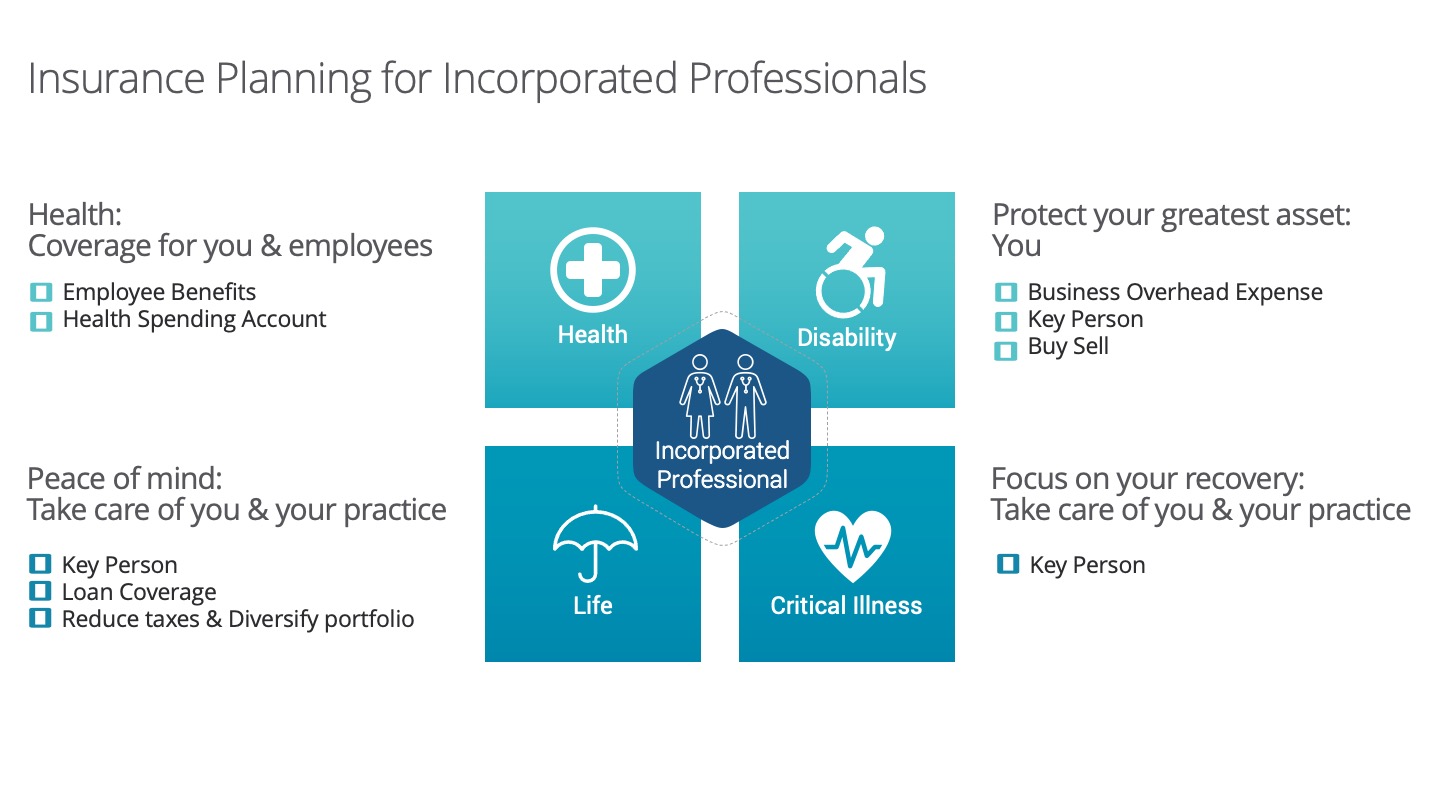
Insurance Planning for Incorporated Professionals

For incorporated professionals, making sure your practice is financially protected can be overwhelming. Incorporated professionals face a unique set of challenges when it comes to managing risk. Insurance can play an important role when it comes to reducing the financial impact on your practice in the case of uncontrollable events such as disability, or critical illness. This infographic and article address the importance of corporate insurance.

The 4 areas of insurance a incorporated professional should take care of are: 

  • Health 

  • Disability 

  • Critical Illness 

  • Life

Health: We are fortunate in Canada, where the healthcare system pays for basic healthcare services for Canadian citizens and permanent residents. However, not everything healthcare related is covered, in reality, 30% of our health costs* are paid for out of pocket or through private insurance such as prescription medication, dental, prescription glasses, physiotherapy, etc.

For incorporated professionals, offering employee health benefits make smart business sense because health benefits can form part of a compensation package and can help retain key employees and attract new talent.

For incorporated professionals that are looking to provide alternative health plans in a cost effective manner, you may want to consider a health spending account.

Disability: Most people spend money on protecting their home and car, but many overlook protecting their greatest asset: their ability to earn income. Unfortunately one in three people on average will be disabled for 90 days or more at least once before the age of 65.

Consider the financial impact this would have on your practice if you or a key employee were to suffer from an injury or illness. Disability insurance can provide a monthly income to help keep your practice running.

Business overhead expense insurance can provide monthly reimbursement of expenses during total disability such as rent for commercial space, utilities, employee salaries and benefits, equipment leasing costs, accounting fees, insurance premiums for property and liability, etc.

Key person disability insurance can be used to provide monthly funds for you or key employee while they’re disabled and protect the business from lost revenue while your business finds and trains an appropriate replacement.

Critical Illness: For a lot of us, the idea of experiencing a critical illness such as a heart attack, stroke or cancer can seem unlikely, but almost 3 in 4 (73%) working Canadians know someone who experience a serious illness. Sadly, this can have serious consequences on you, your family and business, with Critical Illness insurance, it provides a lump sum payment so you can focus on your recovery.

Key person critical illness insurance can be used to provide funds to the practice so it can supplement income during time away, cover debt repayment, salary for key employees or fixed overhead expenses.

Buy sell critical illness insurance can provide you with a lump sum payment if your business partner or shareholder were to suffer from a critical illness. These funds can be used to purchase the shares of the partner, fund a buy sell agreement and reassure creditors and suppliers.

Life: For an incorporated professional, not only do your employees depend on you for financial support but your loved ones do too. Life insurance is important because it can protect your practice and also be another form of investment for excess funds.

Key person life insurance can be used to provide a lump sum payment to the practice on death of the insured so it can keep the business going until you an appropriate replacement is found. It can also be used to retain loyal employees by supplying a retirement fund inside the insurance policy.

Loan coverage life insurance can help cover off any outstanding business loans and debts.

Reduce taxes & diversify your portfolio, often life insurance is viewed only as protection, however with permanent life insurance, there is an option to deposit excess funds not needed for operations to provide for tax-free growth (within government limits) to diversify your portfolio and reduce taxes on passive investments.  

Talk to us to make sure you and your practice are protected.

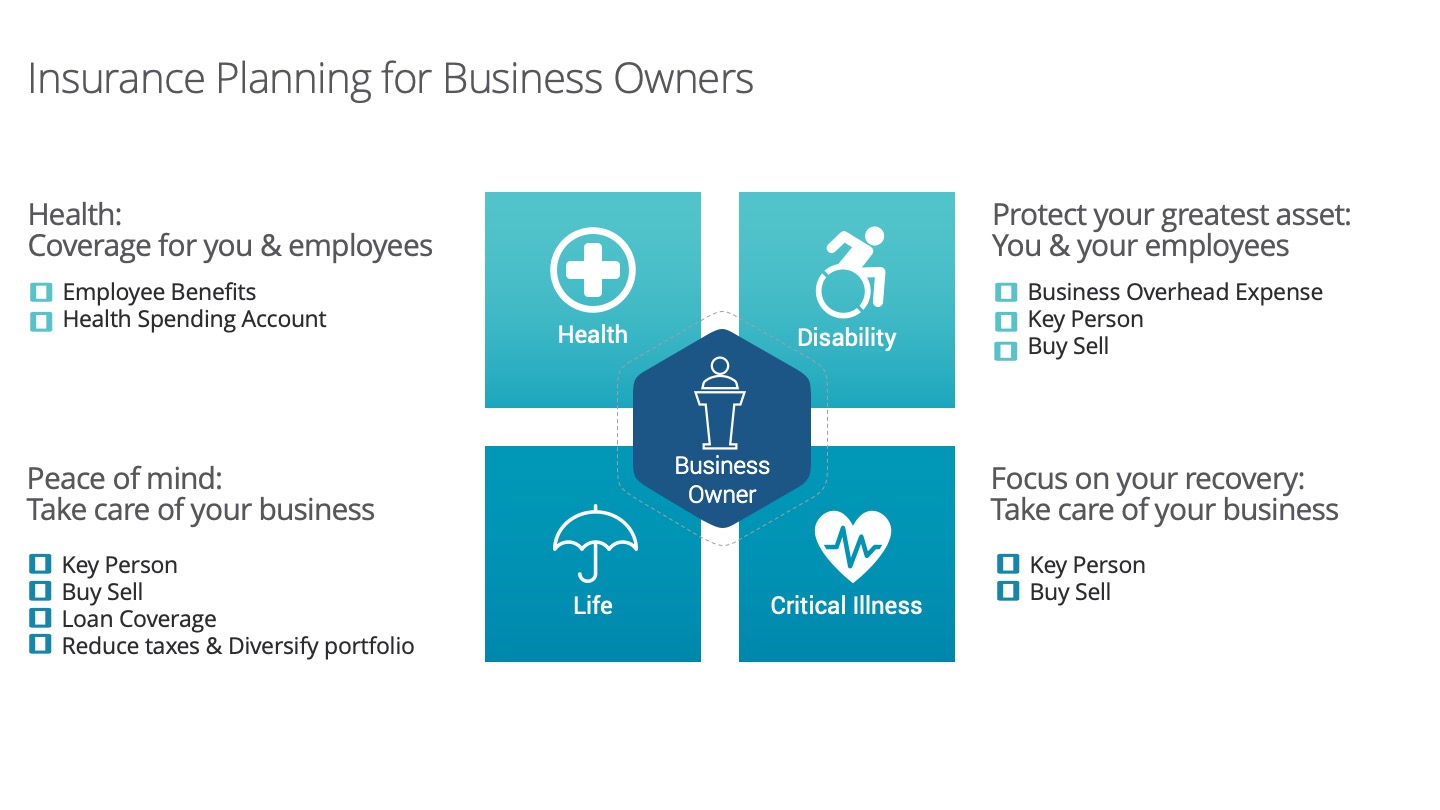
Insurance Planning for Business Owners

For business owners, making sure your business is financially protected can be overwhelming. Business owners face a unique set of challenges when it comes to managing risk. Insurance can play an important role when it comes to reducing the financial impact on your business in the case of uncontrollable events such as disability, critical illness or loss of a key shareholder or employee.

This infographic addresses the importance of corporate insurance.

The 4 areas of insurance a business owner should take care of are:

  • Health

  • Disability

  • Critical Illness

  • Life

Health: We are fortunate in Canada, where the healthcare system pays for basic healthcare services for Canadian citizens and permanent residents. However, not everything healthcare related is covered, in reality, 30% of our health costs* are paid for out of pocket or through private insurance such as prescription medication, dental, prescription glasses, physiotherapy, etc.

For business owners, offering employee health benefits make smart business sense because health benefits can form part of a compensation package and can help retain key employees and attract new talent.

For business owners that are looking to provide alternative health plans in a cost effective manner, you may want to consider a health spending account.

Disability: Most people spend money on protecting their home and car, but many overlook protecting their greatest asset: their ability to earn income. Unfortunately one in three people on average will be disabled for 90 days or more at least once before the age of 65.

Consider the financial impact this would have on your business if you, a key employee or shareholder were to suffer from an injury or illness. Disability insurance can provide a monthly income to help keep your business running.

Business overhead expense insurance can provide monthly reimbursement of expenses during total disability such as rent for commercial space, utilities, employee salaries and benefits, equipment leasing costs, accounting fees, insurance premiums for property and liability, etc.

Key person disability insurance can be used to provide monthly funds for the key employee while they’re disabled and protect the business from lost revenue while your business finds and trains an appropriate replacement.

Buy sell disability insurance can provide you with a lump sum payment if your business partner were to become totally disabled. These funds can be used to purchase the shares of the disabled partner, fund a buy sell agreement and reassure creditors and suppliers.

Critical Illness: For a lot of us, the idea of experiencing a critical illness such as a heart attack, stroke or cancer can seem unlikely, but almost 3 in 4 (73%) working Canadians know someone who experience a serious illness. Sadly, this can have serious consequences on you, your family and business, with Critical Illness insurance, it provides a lump sum payment so you can focus on your recovery.

Key person critical illness insurance can be used to provide funds to the company so it can supplement income during time away, cover debt repayment, salary for key employees or fixed overhead expenses.

Buy sell critical illness insurance can provide you with a lump sum payment if your business partner or shareholder were to suffer from a critical illness. These funds can be used to purchase the shares of the partner, fund a buy sell agreement and reassure creditors and suppliers.

Life: For a business owner, not only do your employees depend on you for financial support but your loved ones do too. Life insurance is important because it can protect your business and also be another form of investment for excess company funds.

Key person life insurance can be used to provide a lump sum payment to the company on death of the insured so it can keep the business going until you an appropriate replacement is found. It can also be used to retain loyal employees by supplying a retirement fund inside the insurance policy.

Buy sell life insurance can provide you with a lump sum payment if your business partner or shareholder were to pass away. These funds can be used to purchase the shares of the deceased partner, fund a buy sell agreement and reassure creditors and suppliers.

Loan coverage life insurance can help cover off any outstanding business loans and debts.

Reduce taxes & diversify your portfolio, often life insurance is viewed only as protection, however with permanent life insurance, there is an option to deposit excess company funds not needed for operations to provide for tax-free growth (within government limits)  to diversify your portfolio and reduce taxes on passive investments.

Talk to us about helping making sure you and your business are protected.

Group Retirement Benefits

Working at an organization that offers a pension plan is one of the greatest financial advantages a Canadian can enjoy. Pension plans are designed to provide retirement income and help employees reach their retirement goals and for business owners- help retain key employees.

Pension plans can offer:

  • Employer contributions

  • Forced retirement savings for employee

There are 2 main types of pension plan:

  • Defined Benefit Plan

  • Defined Contribution Plan

Defined Benefit Plan

  • Retirement income is guaranteed, contributions are not.

  • The pension amount is based on a formula that includes the employee’s earnings and years of service with the employer

  • Usually, contributions are made by the employee and employer

  • The employer is responsible for investing the contributions to ensure there’s enough money to pay the future pensions for all plan members.

  • If there’s a shortfall, the employer pays the difference.

Defined Contribution Plan

  • Contributions are guaranteed, retirement income is not.

  • Usually, contributions are made by the employee and employer.

  • The employee is responsible for investing all contributions.

  • The amount available in retirement depends on how the investment performs including total contributions.

  • At retirement, the money in the account can be used to generate retirement income through purchasing an annuity or transferring the amount to a locked-in retirement income fund.

In summary, a defined benefits plan guarantees you a retirement income and a defined contribution plan guarantees contributions but not retirement income.

Talk to us, we can help.