
Do you REALLY need life insurance?

You most likely do, but the more important question is, What kind? Whether you’re a young professional starting out, a devoted parent or a successful CEO, securing a life insurance policy is probably one of the most important decisions you will have to make in your adult life. Most people would agree that having financial safety nets in place is a good way to make sure that your loved ones will be taken care of when you pass away. Insurance can also help support your financial obligations and even take care of your estate liabilities. The tricky part, however, is figuring out what kind of life insurance best suits your goals and needs. This quick guide will help you decide what life insurance policy is best for you, depending on who needs to benefit from it and how long you’ll need it. 

Permanent or Term? 

Life insurance can be classified into two principal types: permanent or term. Both have different strengths and weaknesses, depending on what you aim to achieve with your life insurance policy. 

Term life insurance provides death benefits for a limited amount of time, usually for a fixed number of years. Let’s say you get a 30-year term. This means you’ll only pay for each year of those 30 years. If you die before the 30-year period, then your beneficiaries shall receive the death benefits they are entitled to. After the period, the insurance shall expire. You will no longer need to pay premiums, and your beneficiaries will no longer be entitled to any benefits.

Term life insurance is right for you if you are: 

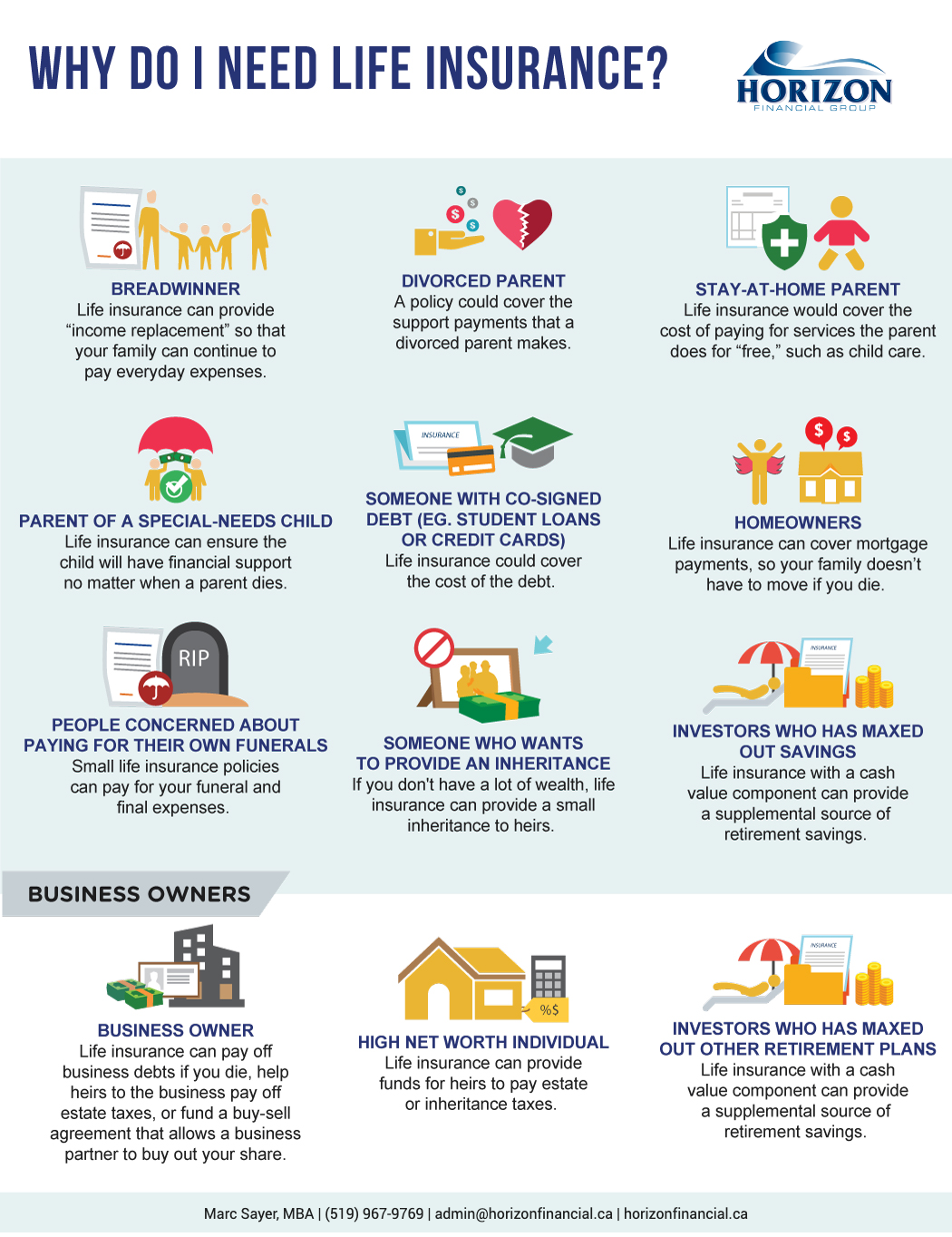
  • The family breadwinner. Death benefits will replace your income for the years that you will have been working, in order to support your family’s needs.

  • A stay-at-home parent. You can set your insurance policy term to cover the years that your child will need financial support, especially for things that you would normally provide as a stay-at-home parent, such as childcare services.

  • A divorced parent. Insurance can cover the cost of child support, and the term can be set depending on how long you need to make support payments.

  • A mortgagor. If you are a homeowner with a mortgage, you can set up your term insurance to cover the years that you have to make payments. This way, your family won’t have to worry about losing their home.

  • A debtor with a co-signed debt. If you have credit card debt or student loans, a term life insurance policy can cover your debt payments. The term can be set to run for the duration of the payments. 

  • A business owner. If you’re a business owner, you may need either a term or permanent life insurance, depending on your needs. If you’re primarily concerned with paying off business debts, then a term life insurance may be your best option. 

Unlike term life insurance, a permanent life insurance does not expire. This means that your beneficiaries can receive death benefits no matter when you die. Aside from death benefits, a permanent life insurance policy can also double as a savings plan. A certain portion of your premiums can build cash value, which you may “withdraw” or borrow for future needs. You can do well with a permanent life insurance policy if you: 

  • …Have a special needs child. As a special needs child will most likely need support for health care and other expenses even as they enter adulthood. Your permanent life insurance can provide them with death benefits any time within their lifetime.

  • …Want to leave something for your loved ones. Regardless of your net worth, permanent life insurance will make sure that your beneficiaries receive what they are entitled to. If you have a high net worth, permanent life insurance can take care of estate taxes. Otherwise, they will still get even a small inheritance through death benefits.

  • …Want to make sure that your funeral expenses are covered. Final expense insurance can provide coverage for funeral expenses for smaller premiums.

  • …Have maximized your retirement plans. As permanent life insurance may also come with a savings component, this can also be used to help you out during retirement.

  • …Own a business. As mentioned earlier, business owners may need either permanent or term, depending on their needs.

A permanent insurance policy can help pay off estate taxes, so that the successors can inherit the business worry-free. Different people have different financial needs, so there is no one-sized-fits-all approach to choosing the right insurance policy for you. Talk to us now, and find out how a permanent or term life insurance can best give you security and peace of mind. 

Guide to Covid-19: Government Relief Programs in Canada

The intention for our “Guide to Covid-19: Government Relief Programs in Canada” is to help businesses and individuals to cut through the noise and make sure they’re getting all the help they can receive from the federal and provincial programs.

Federal programs include:

  • Small Business Wage Subsidy

  • Canada Emergency Wage Subsidy

  • Canada Emergency Business Account

  • Canada Emergency Response Benefit

  • Student Loan Programs

Individual provincial programs include:

  • Utilities

  • Housing

  • Student Loan Programs

Succession Planning for Business Owners

Succession Planning for Business Owners

Business owners deal with a unique set of challenges. One of these challenges includes succession planning. A succession plan is the process of the transfer of ownership, management and interest of a business. When should a business owner have a succession plan? A succession plan is required through the survival, growth and maturity stage of a business. All business owners, partners and shareholders should have a plan in place during these business stages.

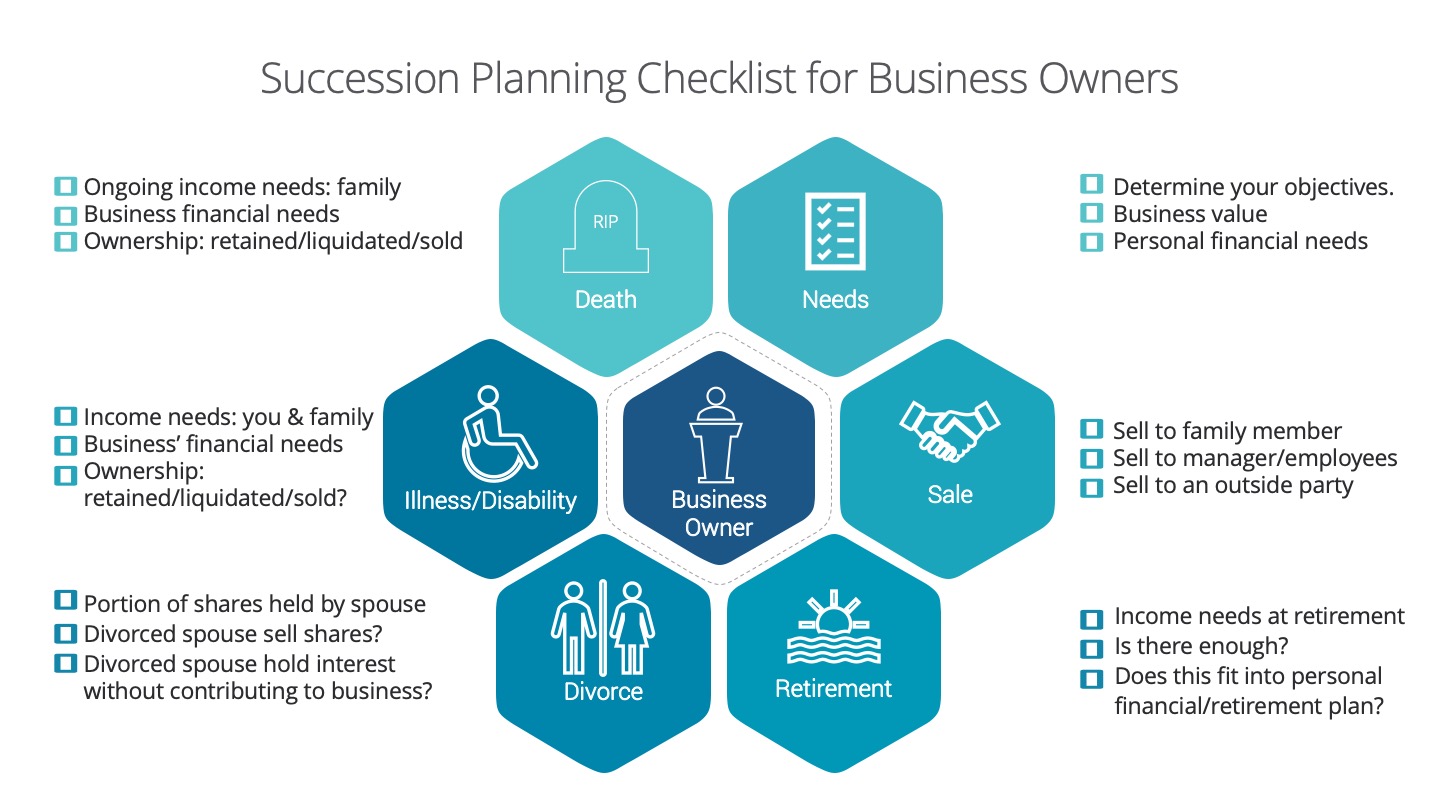
We created this infographic checklist to be used as a guideline highlighting main points to be addressed when starting to succession plan.

Needs:

  • Determine your objectives- what do you want? For you, your family and your business. (Business’ financial needs)

  • What are your shares of the business worth? (Business value)

  • What are your personal financial needs- ongoing income needs, need for capital (ex. pay off debts, capital gains, equitable estate etc.)

There are 2 sets of events that can trigger a succession plan: controllable and uncontrollable.

Controllable events

Sale: Who do you sell the business to?

  • Family member

  • Manager/Employees

  • Outside Party

  • There are advantages and disadvantages for each- it’s important to examine all channels.

Retirement: When do you want to retire?

  • What are the financial and psychological needs of the business owner?

  • Is there enough? Is there a need for capital to provide for retirement income, redeem or freeze shares?

  • Does this fit into personal/retirement plan? Check tax, timing, corporate structures, finances and family dynamics. (if applicable)

Uncontrollable Events

Divorce: A disgruntled spouse can obtain a significant interest in the business.

  • What portion of business shares are held by the spouse?

  • Will the divorced spouse consider selling their shares?

  • What if the divorced spouse continues to hold interest in the business without understanding or contributing to the business?

  • If you have other partners/shareholders- would they consider working with your divorced spouse?

Illness/Disability: If you were disabled or critically ill, would your business survive?

  • Determine your ongoing income needs for you, your spouse and family. Is there enough? If there is a shortfall, is there an insurance or savings program in place to make up for the shortfall amount?

  • Will the ownership interest be retained, liquidated or sold?

  • How will the business be affected? Does the business need capital to continue operating or hire a consultant or executive? Will debts be recalled? Does the business have a savings or insurance program in place to address this?

Death: In the case of your premature death, what would happen to your business?

  • Determine your ongoing income needs for your dependents. Is there enough? If there is a shortfall, is there an insurance or savings program in place to make up for the shortfall amount?

  • Will the ownership interest be retained, liquidated or sold by your estate? Does your will address this? Is your will consistent with your wishes? What about taxes?

  • How will the business be affected? Does the business need capital to continue operating or hire a consultant or executive? Will debts be recalled? How will this affect your employees? Does the business have a savings or insurance program in place to address this?

Execution: It’s good to go through this with but you need to get a succession plan done.  Besides having a succession plan, make sure you have an estate plan and buy-sell/shareholders’ agreement.

Because a succession plan is complex, we suggest that a business owner has a professional team to help. The team should include:

  • Financial Planner/Advisor (CFP)

  • Succession Planning Specialist

  • Insurance Specialist

  • Lawyer

  • Accountant/Tax Specialist

  • Chartered Life Underwriter (CLU)

Next steps…

  • Contact us about helping you get your succession planning in order so you can gain peace of mind that your business is taken care of.

Self Owned vs. Bank Owned Mortgage Insurance

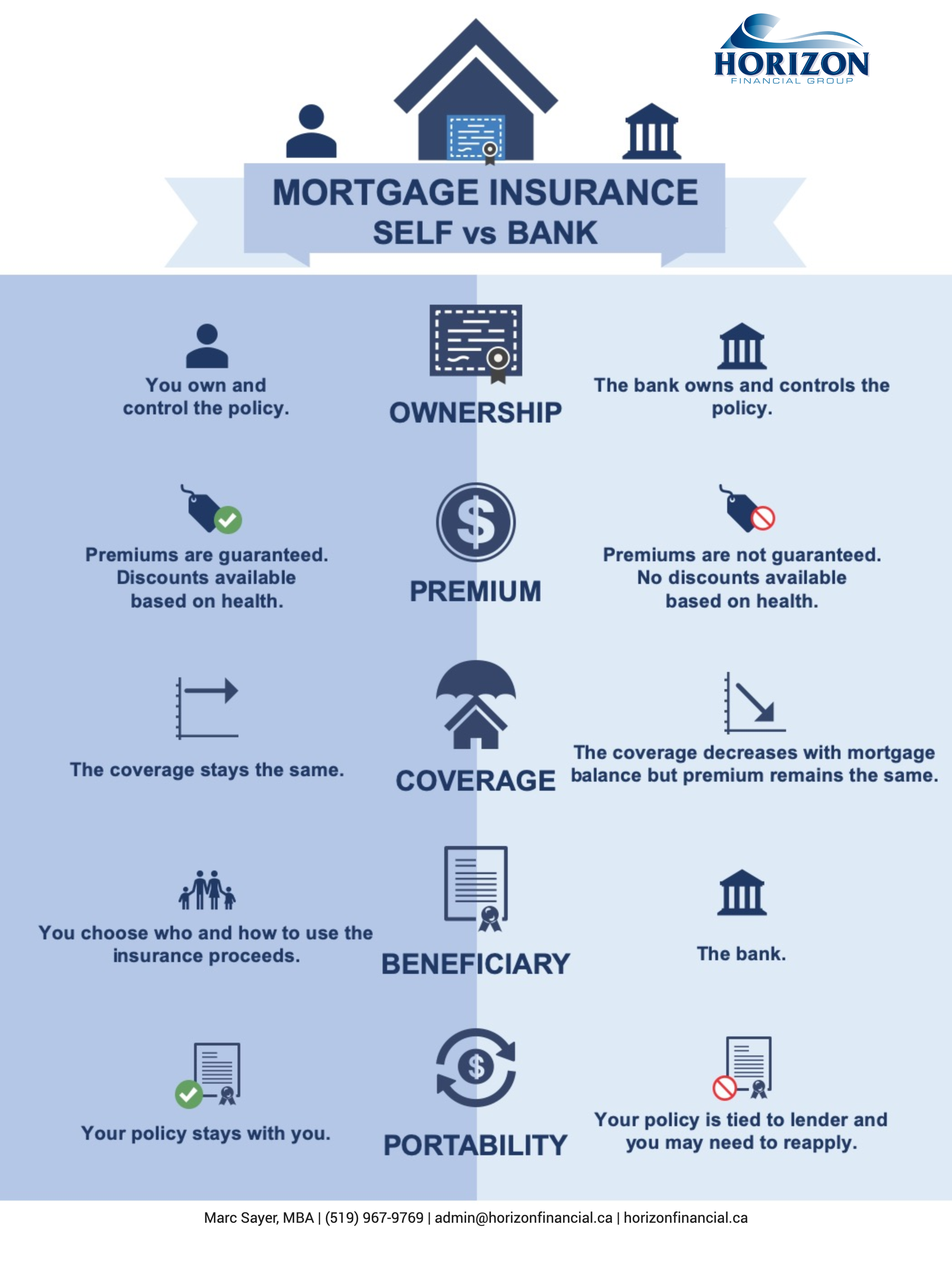
Before buying insurance from your bank to cover your mortgage, understand the difference between self owned mortgage life insurance and bank owned life insurance. The key differences are ownership, premium, coverage, beneficiaries and portability.

Ownership:

  • Self: You own and control the policy.

  • Bank: The bank owns and controls the policy.

Premium:

  • Self: Your premiums are guaranteed at policy issue and discounts are available based on your health.

  • Bank: Premiums are not guaranteed and there are no discounts available based on your health.

Coverage:

  • Self: The coverage that you apply for remains the same.

  • Bank: The coverage is tied to your mortgage balance therefore it decreases as you pay down your mortgage but the premium stays the same.

Beneficiary:

  • Self: You choose who your beneficiary is and they can choose how they want to use the insurance benefit.

  • Bank: The bank is beneficiary and only pays off your mortgage.

Portability:

  • Self: Your policy stays with you regardless of your lender.

  • Bank: Your policy is tied to your lender and if you change, you may need to reapply for insurance.

We’ve created an infographic about the difference between personally owned life insurance vs. bank owned life insurance.

Talk to us, we can help.

Estate Planning for Young Families

Having a family is a blessing and can also bring a lot of worry. A lot of this worry can stem from not being prepared for a disaster like if something were to happen to you or your spouse.

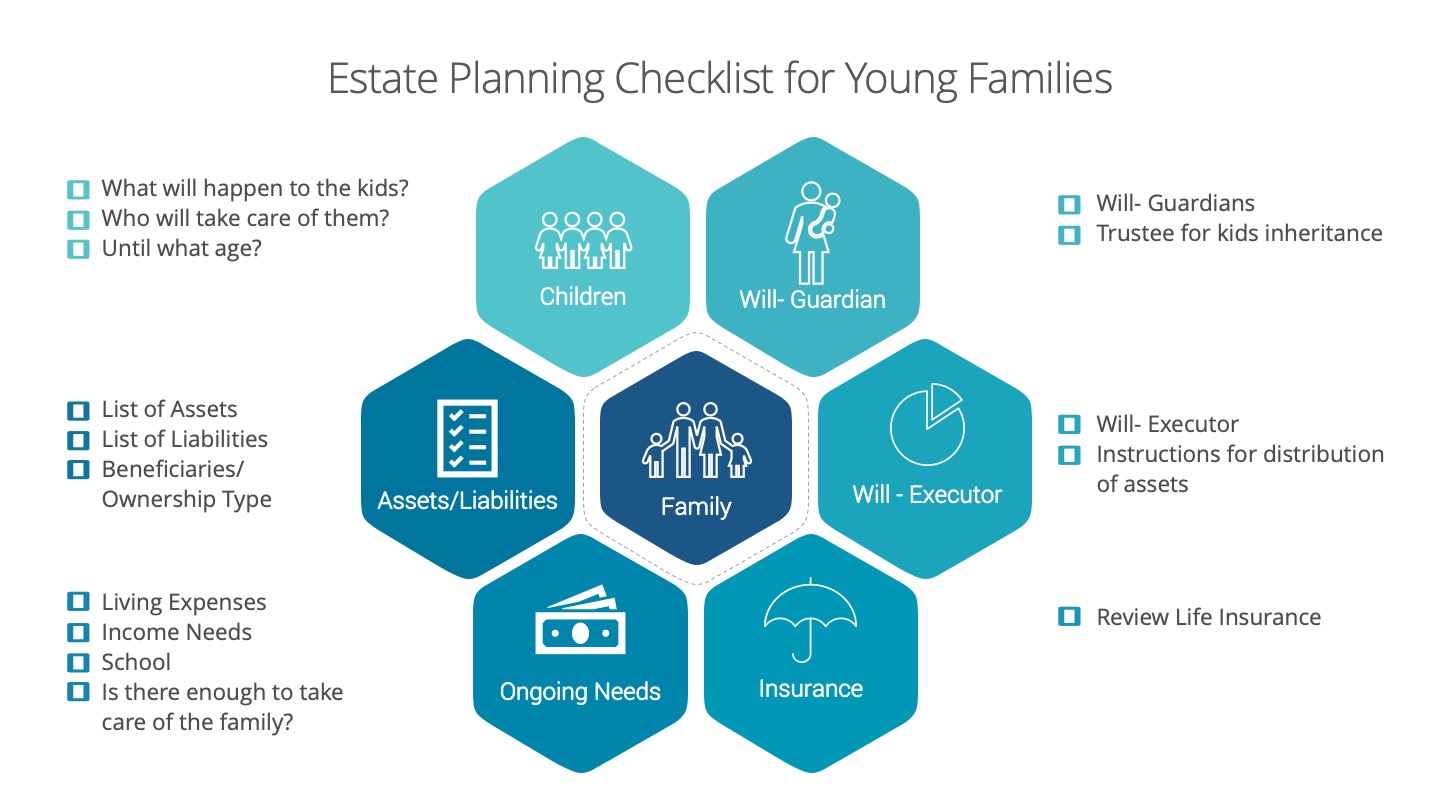
We’ve put together an infographic checklist that can help you get started on this. We know this can be a difficult conversation so we’re here to help and provide guidance.

The Children

  • What will happen to the children if both parents were to pass away?

  • Who would take care of them and until what age?

  • What would happen if only parent were to pass away?

Make sure you have a will that:

  • Assigns a guardian for your children

  • If there’s an inheritance for the children, who will take care of this? Make sure you assign a trustee for the inheritance.

  • Always choose 2 qualified people for each position and communicate your intentions with them to ensure they’re up for the responsibility.

Assets and Liabilities

  • What are your assets? Create a detailed list of your assets such as: Home, Family Business Interest, Investments- Non registered, TFSA, RRSP, RDSP, RESP, Company Pension Plan, Insurance Policy, Property, Additional revenue sources, etc…

  • What are your liabilities? Create a detailed list of your liabilities such as: Mortgage, Loans (personal, student, car), Line of Credit, Credit card, Other loans (payday, store credit card, utility etc.)

  • Understand your assets-the ownership type (joint, tenants in common, sole etc.), list who are the beneficiaries are for your assets

  • Understand your liabilities- who’s on the hook for paying back the loan?

Make sure you have a will that:

  • Assigns an executor

  • Provide specific instructions for distribution of assets

  • Always choose 2 qualified people for each position and communicate your intentions with them to ensure they’re up for the responsibility. 

Ongoing Needs

What are your family’s ongoing needs?

  • List out the living expenses

  • List out income needs

  • Do you still need to pay for school?

  • Determine if you have enough (assets minus liabilities) to take care of the family.

Make sure you review your insurance.

  • Once you determine how much need there is, review your life insurance coverage to see if it meets your needs or if there’s a shortfall.

Execution: It’s good to go through this but you need to do this. Besides doing it yourself, here’s a list of the individuals that can help:

  • Financial Planner/Advisor (CFP)

  • Estate Planning Specialist

  • Insurance Specialist

  • Lawyer

  • Accountant/Tax Specialist

  • Chartered Life Underwriter (CLU)

  • Chartered Executor Advisor (CEA)

There are definitely unique situations in many families and things can get complicated so please use this when you feel it’s applicable.

Next steps…

  • Contact us about helping you get your estate planning in order so you can gain peace of mind that your family is taken care of.

Financial Advice

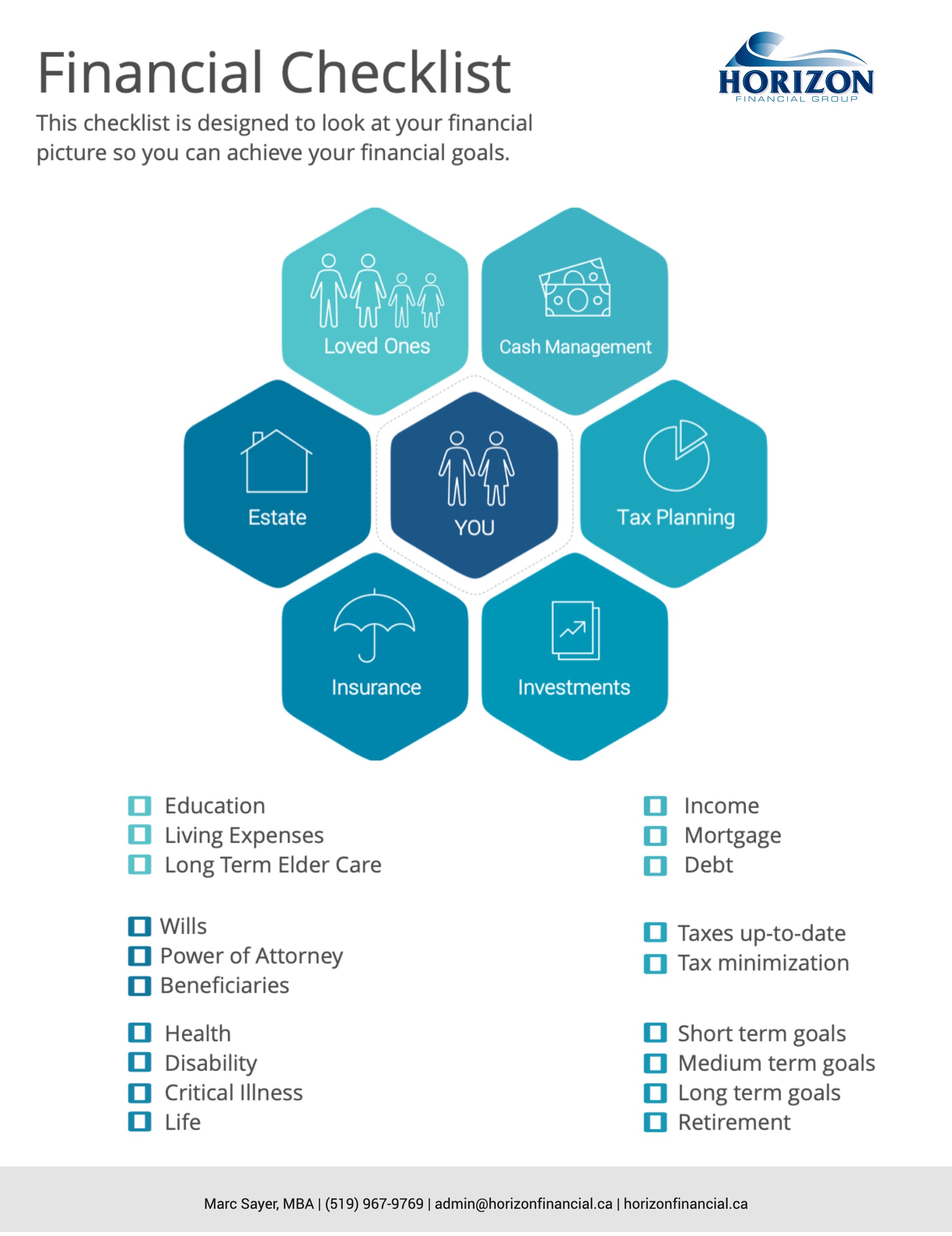
An advisor can help you determine where you are today financially and where you want to go. An advisor can provide you guidance on how to reach your short, medium and long term financial goals.

Why work with a Financial Advisor? 

  • Worry less about money and gain control. 

  • Organize your finances. 

  • Prioritize your goals. 

  • Focus on the big picture. 

  • Save money to reach your goals.

What can a Financial Advisor help you with? 

Advisors can help you with accumulation and protection

Accumulation: 

  • Cash Management – Savings and Debt

  • Tax Planning

  • Investments

Protection: 

  • Insurance Planning

  • Health Insurance

  • Estate Planning

How do you start? 

  • Establish and define the financial advisor-client relationship.

  • Gather information about current financial situation and goals including lifestyle goals. 

  • Analyze and evaluate current financial status. 

  • Develop and present strategies and solutions to achieve goals. 

  • Implement recommendations. 

  • Monitor and review recommendations. Adjust if necessary. 

Next steps…

  • Talk to us about helping you get your finances in order so you can achieve your lifestyle and financial goals. 

  • Feel confident in knowing you have a plan to get to your goals.